
What are the specific parameters and uses of municipal guardrails?
author
December 17, 2025
Municipal guardrails are a type of municipal facility that we often see, but we don’t know much about the specific parameters and uses of this type of municipal facility.
We just think that this type of guardrail has a certain degree of aesthetics, strength, and impact resistance. Everyone thinks that this type of guardrail is not a big deal. In fact, this type of guardrail has been carefully designed to meet the corresponding requirements in terms of performance parameters, otherwise it cannot be put into specific use. Therefore, we will briefly introduce the common parameter characteristics of the guardrail’s use.
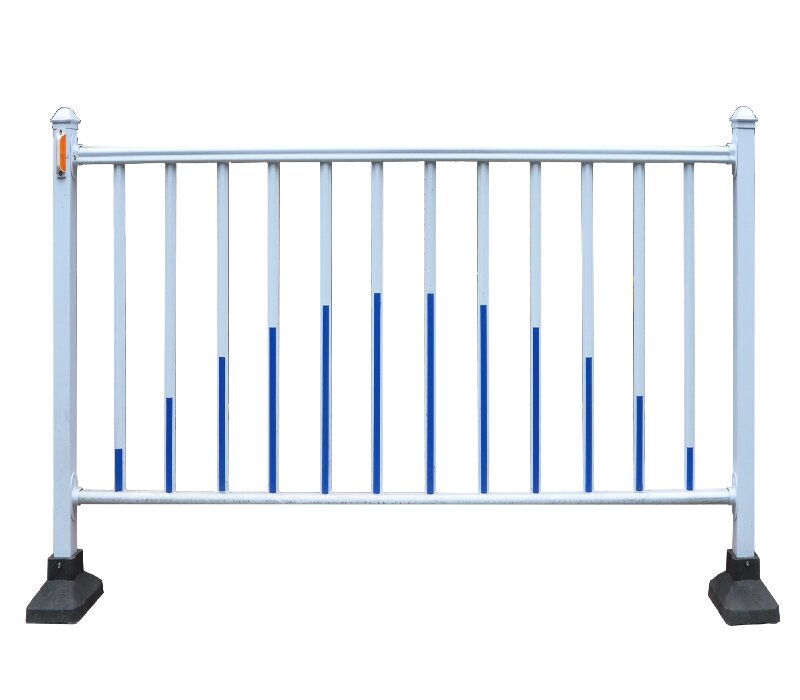
The most common type of municipal guardrail is the blue and white version.
The common parameters for this type of guardrail are a height of 1.2 meters and a length of 3.08 meters. In addition, there are also 0.8 meters and 1 meter high ones. This type of guardrail has good anti-corrosion performance and is very easy to install. It is widely used in municipal roads in many cities, serving both as a barrier and a decorative effect.
One of the most common types of municipal guardrail products is the guardrail net.
Northerners like to call it this name, but friends in the south generally refer to it directly as the enclosure fence. This type of guardrail is more commonly used in airports or sports stadiums. According to its desired specific form, it can be divided into different mesh structures such as wave mesh or frame mesh. Its parameters mainly have two aspects. The first parameter is the mesh aperture. Nowadays, most mesh apertures are 75150, and the frame parameters are mainly 20301.5, which are more commonly used.
Another type of guardrail is a triangular guardrail, with a size of 50180.
If it is a triangular guardrail with columns, the size is generally 2.32.9. Its main feature is its good strength, and the rigidity of this guardrail is also very good. In terms of appearance, it not only serves as a barrier or obstruction, but also does not have to worry about affecting the vision. You can directly see the opposite scene through the guardrail, which is often used in some traffic tunnels that need to be closed. This product can be processed through certain techniques to give it different colors or shapes, such as some being yellow, while others are green or red.
Guardrails in coastal areas need to undergo dual anti-corrosion treatment of hot-dip galvanizing and fluorocarbon spraying to enhance their salt spray resistance.
School guardrails must comply with the "Safety and Prevention Requirements for Primary and Secondary Schools and Kindergartens", have no sharp edges or corners, and have a protection height of not less than 1.2 meters.
Choose a combination of imitation wood and green plants guardrail, with transparent mesh and natural color scheme, which not only isolates and protects but also does not damage the landscape.
RELATED PRODUCTS
A tale of a fateful trip that started from this tropic port aboard this tiny ship today stillers
River guardrails are safety protection facilities specifically designed for the banks of rivers, lakes, and other water bodies. With "fall prevention, water corrosion resistance, and landscape adaptation" as the core functions, they are made of weather resistant substrates such as galvanized steel and stainless steel, reinforced and welded, and treated with anti-corrosion. It can not only prevent people and objects from accidentally falling into water bodies, but also adapt to the high humidity and abundant water environment of rivers. At the same time, it can be integrated with waterfront landscapes through its shape, color matching, and is a key facility to ensure the safety of water bodies and enhance the ecological environment. It is widely used in urban river trails, wetland park shorelines, reservoir shorelines, and other scenes.
High speed anti glare mesh guardrail, also known as steel mesh guardrail or metal anti glare mesh, is a key active traffic safety facility specifically used for the median strip of highways. The core design concept is to effectively block the harmful glare generated by oncoming vehicles driving at night, prevent traffic accidents, and ensure that drivers have good lateral vision ability to observe the road conditions diagonally ahead and reduce psychological depression. The product is made of high-quality low-carbon steel plate through precision mechanical stamping and expansion, forming a continuous and uniform diamond or rectangular mesh structure. Compared with traditional solid anti glare panels, this unique mesh design combines multiple functions such as anti glare, isolation, reduced wind resistance, and transparent visibility. It is an economically efficient and technologically mature road safety solution, widely used in highway systems in China and many parts of the world.
High strength woven guardrails for highways, often referred to as "Dutch mesh" guardrails, are a high-performance metal mesh guardrail system made using special mechanical weaving techniques. Its core feature is that high-strength steel wire is pre bent into a continuous and regular wave shape (also known as a "sine wave" shape), and then precision woven to form a metal protective net that combines great flexibility, integrity, and tensile strength. This unique structure enables it to effectively absorb and disperse energy through elastic deformation when subjected to impact, rather than rigid fracture, making it particularly suitable for highway isolation and closure, slope protection, bridge anti throwing, and anti glare applications in some areas that require long-term durability, impact resistance, and intrusion prevention.
Highway isolation barriers are the most core and widely used passive protection system in highway traffic safety facilities. It mainly refers to rigid or semi-rigid guardrails continuously set along both sides of the main highway and the central median. Its core function is to absorb collision energy through self deformation, force the direction of out of control vehicles, and effectively prevent vehicles from crossing the boundary (rushing out of the road or crossing the median), thereby minimizing the severity of accidents and protecting the safety of drivers and passengers. According to the different levels of protection, structural forms, and installation locations, it is mainly divided into two categories: roadside guardrails and median barriers. In terms of materials, mainstream products include corrugated steel guardrails (double wave/triple wave), concrete guardrails (New Jersey/F-type), and steel cable guardrails (flexible). Among them, corrugated steel guardrails are widely used worldwide due to their good protective performance, moderate cost, and aesthetics.